


$
Jury Verdict
$ 10 Million
Medical Malpractice
Luzerne County


 Millions Recovered
Millions won for victims, including Luzerne County's largest medical malpractice verdict.
 Certified Trial Advocacy
Led by one of few female Board Certified Trial Advocates in Pennsylvania.
 Zero Upfront Cost
You don't pay a penny out of pocket, we only get paid when you do.
 Years of Experience
100+ combined years of experience in personal injury, medical malpractice, and criminal defense.
Scartelli Olszewski has tried serious injury cases in Lackawanna County since 2001. Cases settle for serious money when the firm on the other side is ready to try them. Our results across medical malpractice, trucking, auto, premises liability, product liability, dram shop, and wrongful death include a $10 million jury verdict in a medical malpractice case, the largest birth injury settlement in Lackawanna County history, and a precedent-setting punitive damages verdict against a doctor in Luzerne County. We file and try cases in the Lackawanna County Court of Common Pleas at 200 N. Washington Avenue, minutes from our Scranton office at 411 Jefferson Avenue.
In 2024, Pennsylvania recorded 110,765 reportable traffic crashes statewide, with 66,950 people injured and 1,127 killed, according to PennDOT’s Pennsylvania Crash Facts and Statistics 2024. Beyond the crash numbers, Lackawanna County personal injury filings span trucking, medical malpractice, premises liability, products liability, dram shop, and wrongful death. The I-81, I-84, and I-380 corridors, the I-476 Northeast Extension, and the Route 6 commercial belt drive a sustained share of the volume. A hospital-dense Scranton market drives the medical malpractice volume. The continued growth of warehousing and distribution along I-81 drives the trucking volume.
Scartelli Olszewski, P.C. is led by Melissa A. Scartelli, founder, president, and Board Certified Civil Trial Advocate by the National Board of Trial Advocacy.
Proven Results in Pennsylvania Personal Injury Cases:
See our full case results, read what our clients have said, or meet our attorneys.
Call our Scranton office at (570) 346-2600 or visit 411 Jefferson Avenue, Scranton, PA 18510 for a free, confidential case review. We are minutes from the Lackawanna County Court of Common Pleas at 200 N. Washington Avenue where Scranton-area cases are filed.
Past results do not guarantee a similar outcome. Every case is unique and the value of any claim depends on its specific facts.
Most personal injury cases in Lackawanna County fall into a recognizable set of categories. Each has its own evidence-preservation timeline, its own statutory framework, and its own conversion path. Click through to the dedicated Scranton page for each practice area for the full treatment.
Car accidents are the highest-volume category in Lackawanna County and the most likely to involve the Pennsylvania tort election (full vs. limited tort under 75 Pa.C.S. §§ 1702 and 1705), modified comparative negligence under 42 Pa.C.S. § 7102, and Paul Miller’s Law on hands-free driving (75 Pa.C.S. § 3316.1, eff. June 5, 2025). For a comprehensive walkthrough of Pennsylvania car accident law and how it applies to Lackawanna County crashes, see our Scranton car accident lawyer page. Common Scranton-area fact patterns include rear-end collisions on I-81, T-bone crashes at intersections downtown, hit-and-run patterns, multi-vehicle pile-ups in winter weather, and rideshare crashes (Uber and Lyft) where the policy stack shifts depending on whether the driver was active on the app at the moment of impact.
Trucking cases are usually larger because federal financial responsibility minimums under 49 C.F.R. § 387.9 require commercial carriers to maintain coverage well above ordinary auto policy limits, and because the underlying injuries are more severe. The case-defining work happens in the first days, not the first months: ELD records, EDR downloads, driver qualification files, drug and alcohol test results, dispatch communications, and dashcam video are perishable. We send formal preservation letters within hours and pursue spoliation sanctions where appropriate. The growth of warehousing and distribution along I-81 has produced sustained heavy commercial traffic through Lackawanna County, with recurring serious-crash patterns near warehouse-district exits in Dunmore, Jessup, Olyphant, and Pittston. See the Scranton truck accident lawyer page or call (570) 346-2600.
Motorcyclists in Pennsylvania always retain full tort rights and are excluded from the no-fault PIP framework, which means recovery for pain and suffering does not require crossing any injury threshold. The challenge in motorcycle cases is anti-rider bias from adjusters, who reflexively reach for “speeding,” “weaving,” or “no helmet” to push fault onto the rider. We counter that bias with accident reconstruction, EDR data from the at-fault vehicle, intersection footage, and witness statements. Common fact patterns in Lackawanna County include left-turn-across-path collisions at intersections, lane-change sideswipes on I-81 and I-84, and curve-and-gravel crashes on Route 307. See the Scranton motorcycle accident lawyer page for the full treatment, or call (570) 346-2600.
When care at a hospital, clinic, or doctor’s office causes serious harm, these cases demand medical experts, MCARE Act experience, and attorneys who try cases to verdict. Our Scranton medical malpractice lawyers hold a $10 million verdict, the largest in Luzerne County history.
Property owners in Pennsylvania owe duties that vary based on the visitor’s status (invitee, licensee, trespasser) and the nature of the hazard (open and obvious, latent, naturally occurring). The case-defining work in slip and fall is evidence preservation: incident reports, surveillance footage, maintenance logs, prior complaints, and weather records are perishable. The “hills and ridges” doctrine continues to limit liability for natural snow and ice accumulations under Pennsylvania law and is a recurring defense in winter slip and fall claims. See the Scranton slip and fall lawyer page.
Pedestrians and cyclists struck by motor vehicles are not subject to the limited tort election under 75 Pa.C.S. § 1705, so full pain and suffering recovery is preserved regardless of the injured person’s auto insurance election. Common Scranton fact patterns include downtown pedestrian crashes near Public Square and the Marketplace at Steamtown corridor, and cyclist-vehicle crashes on shared-use commuter routes. Surveillance footage from nearby businesses and intersection cameras is the case-defining evidence and gets overwritten in days. See our Pennsylvania car accident lawyer page for the full treatment of tort election exceptions, or call (570) 346-2600.
Pennsylvania dog bite liability operates on a hybrid framework: the Dog Law at 3 P.S. § 459-502-A creates strict liability for medical costs in covered cases, while common law and Section 11 of the Dog Law support recovery of full damages where a “dangerous dog” finding can be made or where the owner’s negligence is proved. Scarring and disfigurement, particularly in pediatric victims, drives non-economic damages in these claims.
When negligence causes death, surviving families can pursue a wrongful death claim under 42 Pa.C.S. § 8301 and a survival action under 42 Pa.C.S. § 8302. The wrongful death claim recovers for the family; the survival action recovers for the estate. Both have a two-year statute of limitations from the date of death. We handle wrongful death across every cause: motor vehicle, trucking, medical malpractice, workplace, dram shop, and product liability. See our understanding wrongful death claims in Pennsylvania explainer or our wrongful death lawyer page.
Catastrophic-injury cases are framed by life care planning, vocational analysis, and economic-loss expert testimony. Lifetime cost of care for severe TBI and for paraplegia and tetraplegia routinely runs into the millions. Symptoms of TBI may not appear immediately; mild concussion can produce lasting cognitive impairment and personality change. Insurance carriers contest causation and severity in every catastrophic case.
Workers’ compensation provides scheduled benefits for injured workers, but workers’ compensation does not bar third-party claims against general contractors, subcontractors, property owners, equipment manufacturers, or other parties whose negligence contributed to the injury. The third-party claim is often where the meaningful recovery sits. We coordinate with workers’ comp counsel where appropriate and pursue the third-party action in parallel. See our Scranton electrocution injury page for one common workplace fact pattern.
Severe burns require multiple surgeries, skin grafts, and lengthy rehabilitation, with permanent scarring, disfigurement, and psychological trauma supporting significant non-economic damages. Burn fact patterns include motor vehicle and trucking fuel-tank ruptures, workplace incidents, defective product explosions and fires, and electrical contact injuries. Burn cases benefit from early engagement of plastic surgery and burn-rehabilitation specialists for the medical record.
Wrong drug, wrong dose, missed interaction warnings, and dispensing errors at the pharmacy can shift liability to the pharmacy and pharmacist independently of any prescribing-physician claim. Pharmacy error cases require careful causation analysis and often run parallel to a medical malpractice claim against the prescriber. See the Scranton pharmacy error lawyer page.
Pennsylvania product liability claims operate under strict liability and negligence theories, with the strict liability framework restated in Tincher v. Omega Flex, Inc., 104 A.3d 328 (Pa. 2014). We pursue claims involving defective drugs, medical device malfunctions, vehicle crashworthiness, defective airbags, and dangerous property conditions. Product liability cases require preservation of the product itself and engineering or scientific expert work.
Pressure sores, dehydration, malnutrition, falls, medication errors, and physical abuse in nursing facilities are signs of systemic understaffing and inadequate supervision. We pull staffing records, incident reports, state inspection findings, and minimum data set reports to expose patterns of neglect.
Pennsylvania’s dram shop law at 47 P.S. § 4-493(1) allows suits against establishments that served a visibly intoxicated patron who then caused harm to a third party. Dram shop work commonly runs parallel to a DUI auto or pedestrian claim and reaches the establishment’s commercial general liability and liquor liability policies on top of the driver’s auto coverage. See the Scranton dram shop lawyer page.
When insurers cross the line into bad faith, meaning they unreasonably deny valid claims, misrepresent policy terms, or refuse to pay what they owe, Pennsylvania law allows a separate bad faith claim under 42 Pa.C.S. § 8371 with additional damages, attorney fees, and interest beyond the original loss. The bad faith standard is the two-prong test from Terletsky v. Prudential as adopted by the Pennsylvania Supreme Court in Rancosky. See the Scranton bad faith insurance attorney page.
Insurance companies offer fast, low settlements hoping you sign before you understand the lifetime cost of your injuries. We calculate the full value of your claim and fight to recover every dollar.
No Cap on Compensatory Damages
Pennsylvania does not cap economic or non-economic damages in personal injury cases. You can recover the full value of your losses.
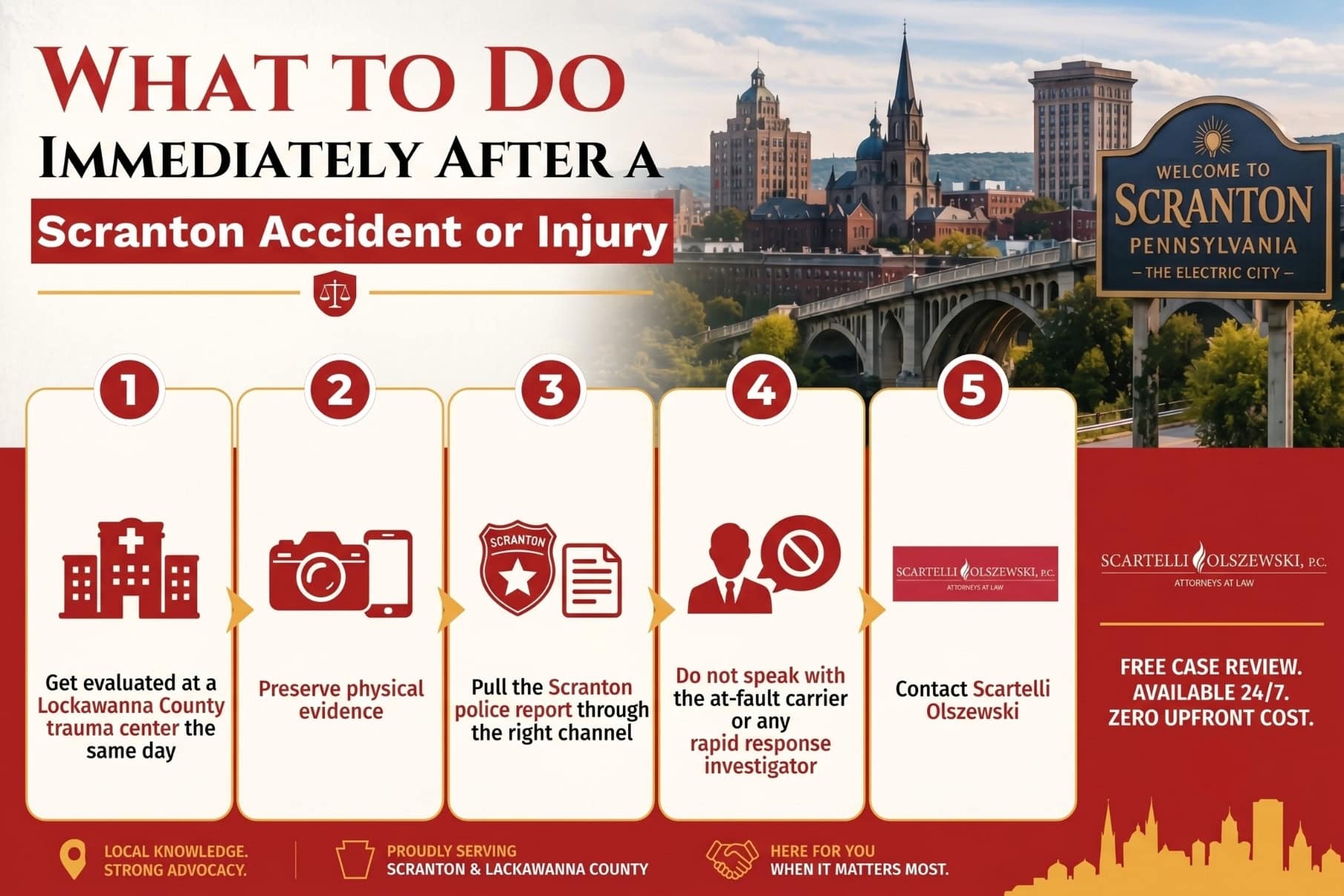
The general scene-response checklist (911, medical, photos, witness contact, no recorded statement, no social media) lives on our what to do after a car accident page. For trucking-specific scene response, see what to do at the scene of a truck accident. A few items are specific to a Scranton-area personal injury case:
Get evaluated at a Lackawanna County trauma center the same day. Geisinger Community Medical Center on Mulberry Street is a Pennsylvania Trauma Systems Foundation Level II accredited trauma center serving the county. Regional Hospital of Scranton and Moses Taylor Hospital operate 24/7 emergency departments. Internal injuries, traumatic brain injury, and spinal damage often have delayed symptoms that the same-day record protects.
Preserve physical evidence. Do not repair, replace, or discard the vehicle, the product, the helmet and gear, or any item connected to the incident until photographed and counsel weighs in.
Pull the Scranton police report through the right channel. See our walkthrough on securing a police report after a car accident in Scranton, PA.
Do not speak with the at-fault carrier or any rapid response investigator. Adjusters call within 24 hours. Trucking carriers dispatch investigators to the scene of catastrophic crashes. There are other things to avoid doing after a crash that can hurt your case.
Contact Scartelli Olszewski. We open the case, send formal preservation letters to the at-fault parties’ carriers (and to commercial defendants and government entities where applicable), and engage the experts the case requires.
From minute one, we handle the adjuster. Call (570) 346-2600 for a free case review.
Nothing upfront. We work on a contingency fee basis under Pa.R.P.C. 1.5(c). You pay no attorney fees unless we recover compensation for you. We advance all case costs, including expert witness fees, accident reconstruction, medical record retrieval, investigation, and court filings.
If we do not win, you owe us nothing.
Understanding how carriers avoid paying claims helps you avoid common traps.
When insurers cross the line into bad faith, meaning they unreasonably deny valid claims, misrepresent policy terms, or refuse to pay what they owe, Pennsylvania law allows a separate bad faith claim under 42 Pa.C.S. § 8371 with additional damages beyond the original loss. We pursue those claims when the facts support them.
Identifying every party responsible for your injury is how we maximize recovery, especially when one defendant’s insurance is not enough to cover your damages.
Pennsylvania law requires four elements in most personal injury cases:
We gather the evidence that proves each element: police reports, sworn witness statements, surveillance and intersection footage, EDR and ELD downloads in vehicle and trucking cases, complete medical records, expert testimony from same-subspecialty physicians in malpractice cases, accident reconstruction in vehicle and product cases, and economic loss expert testimony in catastrophic injury cases.
Pennsylvania law imposes strict deadlines on personal injury claims. Missing them permanently bars your claim, regardless of how strong the evidence is.
Evidence disappears fast. Surveillance and doorbell camera footage gets overwritten in days. ELD and EDR data can be cycled out within weeks. Witnesses become harder to locate. Vehicle and product evidence gets repaired or discarded. We move immediately.
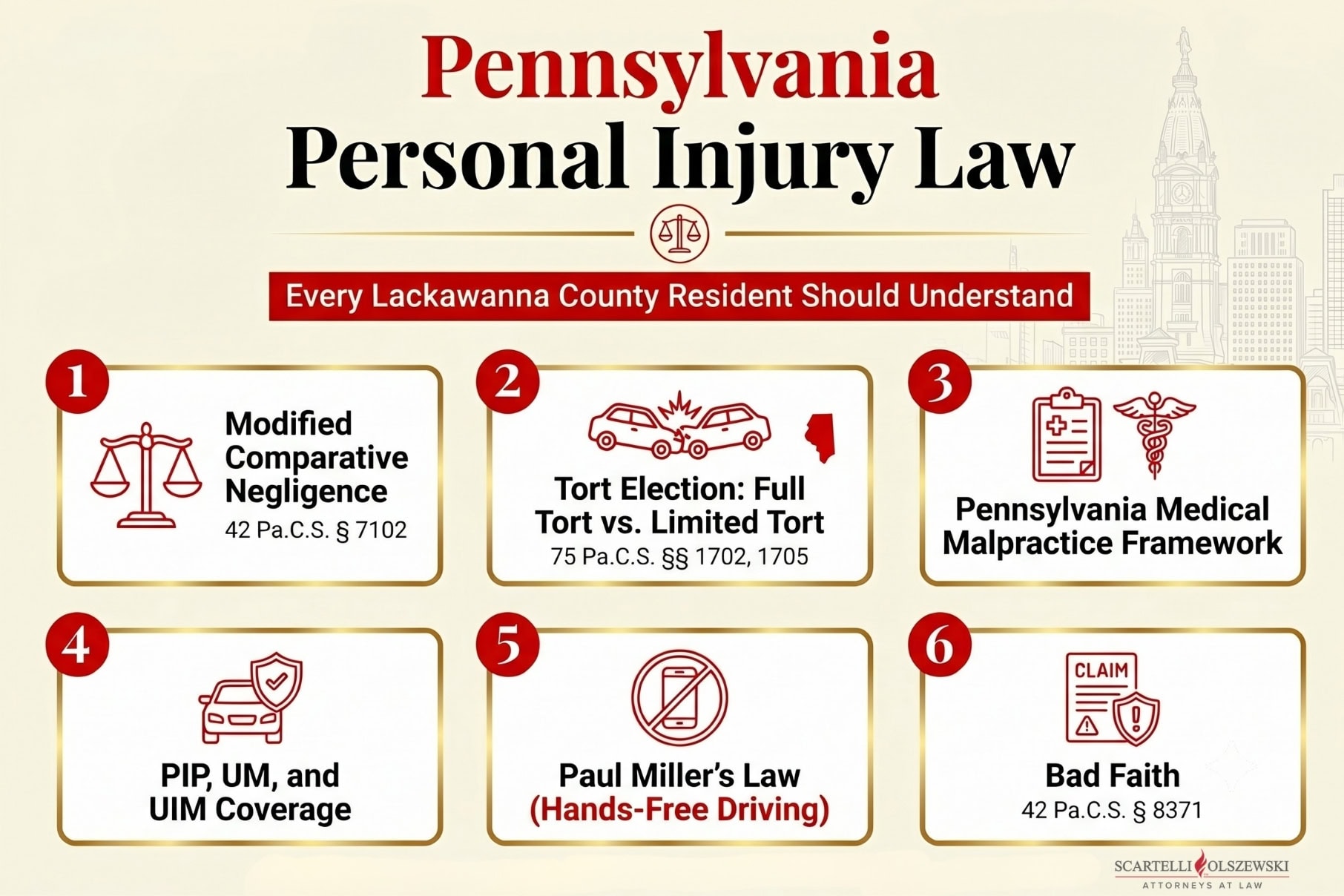
Personal injury cases in Pennsylvania are framed by a handful of statutes and rules that affect how and what you can recover.
Modified Comparative Negligence (42 Pa.C.S. § 7102)
You can recover compensation if you are not more than 50 percent at fault. Your recovery is reduced by your percentage of fault. If you are 51 percent or more at fault, you recover nothing. Insurance adjusters weaponize this rule by blame-shifting. We counter with photographic, video, and reconstruction evidence.
Tort Election: Full Tort vs. Limited Tort (75 Pa.C.S. §§ 1702, 1705)
Limited tort restricts your right to recover pain and suffering damages unless your injuries meet Pennsylvania’s serious injury threshold (death, serious impairment of a bodily function, or permanent serious disfigurement) or unless an exception applies. Common exceptions that unlock full pain and suffering damages even under limited tort include: a DUI conviction or ARD entry by the at-fault driver; an uninsured at-fault driver; an out-of-state vehicle; pedestrian or cyclist injuries; and occupants of a commercial vehicle. Motorcyclists are not subject to the tort election at all because motorcycles are excluded from the no-fault PIP framework under 75 Pa.C.S. § 1711.
Pennsylvania Medical Malpractice Framework
Medical negligence claims follow their own rules under Pennsylvania law; our Pennsylvania medical malpractice lawyers page covers them in full. The Certificate of Merit requirement under Pa.R.C.P. 1042.3, the expert qualification standard under 40 P.S. § 1303.512, the punitive damages framework under 40 P.S. § 1303.505, and the post-Yanakos discovery and tolling framework all govern these claims.
PIP, UM, and UIM Coverage
Pennsylvania requires Personal Injury Protection (PIP), which pays initial medical bills regardless of fault, with a $5,000 state minimum and higher limits available. PIP does not cover pain and suffering. Pennsylvania’s minimum bodily injury liability coverage is $15,000 per person and $30,000 per accident, which is among the lowest in the country. If the injured person carries UM/UIM coverage on their own policy, it can close the gap when the at-fault driver carries minimum limits or no coverage. Pennsylvania law also permits stacking across multiple vehicles, which is critical in serious-injury claims.
Paul Miller’s Law (Hands-Free Driving)
As of June 5, 2025, handheld device use while driving is a primary offense in Pennsylvania under Act 18 of 2024 (Paul Miller’s Law). Through June 4, 2026, violations result in written warnings only; summary citations begin June 5, 2026. Either way, a citation, written warning, or admission of handheld use at the time of a crash is powerful civil liability evidence. We subpoena cell phone records in distracted driving cases.
Bad Faith (42 Pa.C.S. § 8371)
A separate cause of action against an insurer that handles a claim in bad faith. Recovery may include damages beyond the original loss, attorney fees, and interest. The bad faith standard is the two-prong test from Terletsky as adopted by the Pennsylvania Supreme Court in Rancosky.
Lackawanna County is a hospital-dense, freight-heavy market sitting at the convergence of I-81, I-84, I-380, and I-476. The combination drives the regional personal injury caseload.
Nothing upfront. Scartelli Olszewski works on a contingency fee basis under Pa.R.P.C. 1.5(c). The firm advances all case expenses, including expert fees, investigation costs, medical record retrieval, and court filings. You pay a fee only if the case results in a settlement or verdict.
Two years from the date of the injury under 42 Pa.C.S. § 5524 for most personal injury claims. Wrongful death has its own two-year period from the date of death. Claims against government entities require a written notice of claim within six months under 42 Pa.C.S. § 5522(a). Special tolling applies to minors. Federal Tort Claims Act matters have their own administrative process. Some of these alternative deadlines are far shorter than two years. Call promptly.
Yes, if you were not more than 50 percent at fault under Pennsylvania’s modified comparative negligence rule at 42 Pa.C.S. § 7102. Your award is reduced by your percentage of fault. If you are 51 percent or more at fault, you recover nothing.
Full tort coverage allows you to pursue compensation for pain and suffering without restriction. Limited tort restricts that right under 75 Pa.C.S. § 1705 to cases meeting the serious injury threshold under 75 Pa.C.S. § 1702. Several exceptions still unlock full pain and suffering damages even under limited tort, including DUI conviction or ARD entry by the at-fault driver, an uninsured at-fault driver, an out-of-state vehicle, pedestrian or cyclist injuries, and commercial vehicle occupants.
Soft tissue cases with clear liability typically resolve in 6 to 12 months. Cases involving surgery, fractures, or permanent injury take 18 months to 3 years because medical recovery and treatment outcomes need to be fully documented before the case is valued. Medical malpractice and trucking cases often take longer. Cases that go to trial typically take 2 years or more from filing.
Almost never without consulting an attorney. Initial offers rarely reflect the full value of the claim and typically do not account for future medical needs or long-term impacts. Once accepted, you cannot come back for more.
Most personal injury cases settle. Insurance carriers raise their offers when the firm on the other side will take the case to a jury. We prepare every case for trial. If the carrier will not pay fair value, we file suit and try the case in the Lackawanna County Court of Common Pleas.
You may be able to file a wrongful death claim under 42 Pa.C.S. § 8301 and a survival action under 42 Pa.C.S. § 8302. Spouses, children, and parents may have standing to recover. Funeral expenses, lost financial support, and loss of companionship are all recoverable.
If you carry UM coverage on your own policy, it pays for your damages when the at-fault driver lacks coverage or cannot be identified (hit-and-run). Pennsylvania law requires insurers to offer UM coverage on every auto policy under 75 Pa.C.S. § 1731.
You can file a claim against the at-fault driver’s insurance regardless of your relationship to the driver of the vehicle you were riding in. You are not suing a friend or family member personally. You are making a claim against the insurance policy.
Pennsylvania gives you two years to file most personal injury claims and as little as six months to give notice of claims against governmental entities. Evidence becomes harder to collect the longer you wait. The first call is free, and there is no pressure to retain.
We live here, work here, and raise our families in Northeastern Pennsylvania. When you walk into our office, you are not a case number. You are a neighbor, and we handle your case with the seriousness we would bring to one involving our own family.
Call (570) 346-2600. Get a Scranton trial lawyer on your side.
(570) 346-2600 Scranton office | Start your free consultation
Our Scranton office at 411 Jefferson Avenue represents injured clients throughout Lackawanna County and Northeastern Pennsylvania, including Scranton, Dunmore, Dickson City, Old Forge, Moosic, Taylor, Throop, Olyphant, Jessup, Archbald, Carbondale, and Clarks Summit. We also serve Wilkes-Barre, Luzerne County, Monroe County, Wayne County, and Pike County.
Meet our attorneys: Melissa A. Scartelli, Peter Paul Olszewski, Jr., Rachel D. Olszewski, and Kristin A. Mazzarella.
Past results do not guarantee a similar outcome. Every case is unique and the value of any claim depends on its specific facts.
I don't think I could have picked a better team to represent my case. My situation was unique and extremely complicated but it was handled with the utmost care and professionalism. The firm's strong and organized representation ultimately brought great results and helped reconcile a tragic event.
- Jeremy S.
Was wrongly accused of a very serious Felony 3 account and hired Peter Paul Olszewski. The entire firm of Scartelli Olszewski worked tirelessly to have the Pike County Assistant District Attorney as well as the District Magistrate Judge Dismiss the charges! Very pleased with the outcome of this Law Firm and recommend this Law Firm.
- Kerry S.Dealing with the attorneys over at Scartelli Olszewski was nothing short of satisfactory. Through the entire 4 year process we had, I was constantly kept updated and cared for. More than doing their job, they truly care for their clients which I felt off the first meeting with Melissa. Both my family and I are forever thankful for them!
- Noah T. Melissa A. Scartelli
Founder & President
Melissa A. Scartelli
Founder & President
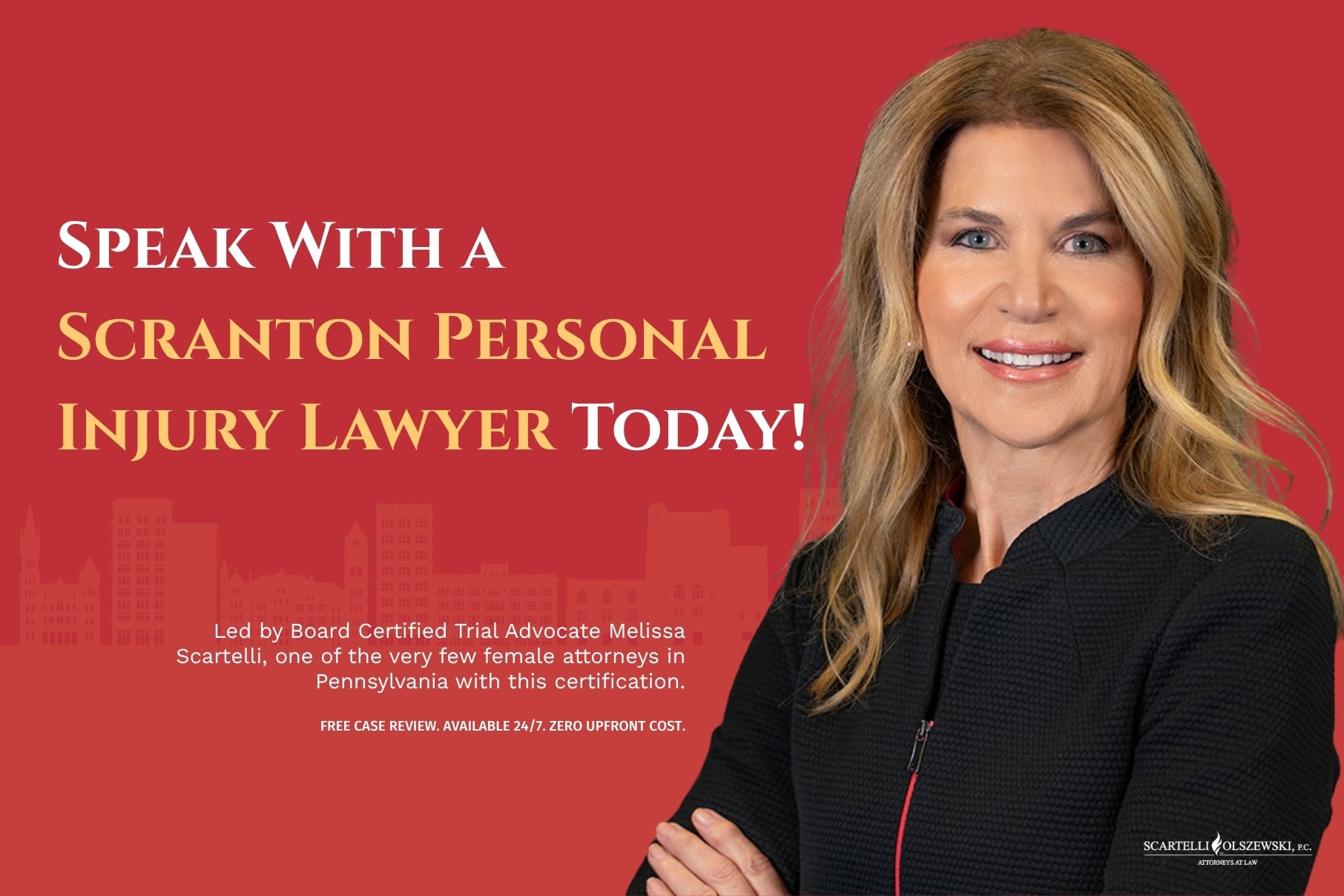
Melissa is a respected Pennsylvania trial attorney, firm founder, and board-certified civil trial advocate recognized for compassionate client service, major case results, and longstanding Super Lawyers honors. Deeply active in the legal community and local institutions, she continues to champion injured clients alongside her family-led legal team.
After an accident, who you hire matters. We've spent years fighting for families just like yours – and we're ready to fight for you.